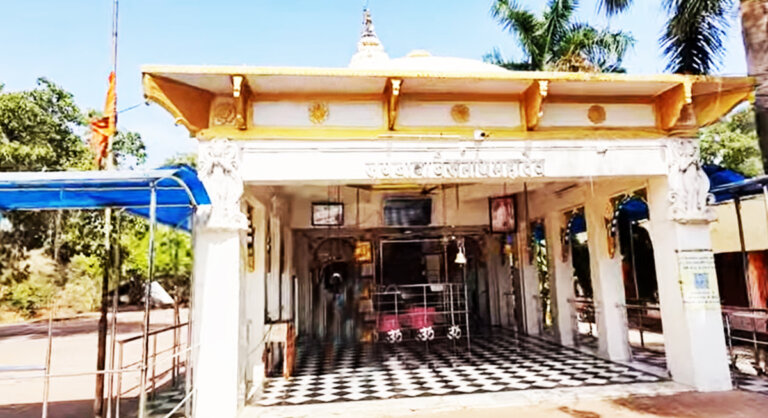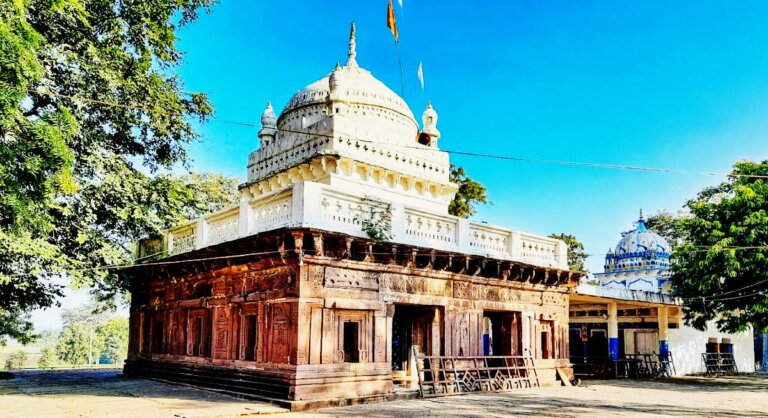

If Jabalpur is considered only a city of marble rocks, the Narmada River, and historic forts, then only half of its story is being told. Located along the banks of Hanumantal in the old part of the city, Hanumantal Bada Jain Temple, also known as Bada Mandir, is an extremely important chapter in Jabalpur’s religious and architectural heritage.
From a distance, the massive temple complex, with its numerous spires and strong exterior structure, looks almost like an ancient fort. This distinctive appearance is one of the temple’s most fascinating features.
According to available historical accounts, the original temple was constructed in 1686 CE, followed by significant reconstruction and expansion during the 19th century. With 22 altars and shrines, the temple complex is regarded as one of the largest independent Jain temple complexes in India.
One of the most fascinating aspects of this temple is its collection of Jain idols associated with different historical periods. Idols connected with the Kalachuri, Mughal, Maratha, British, and modern periods are mentioned here. Entering the temple therefore feels like watching the religious history of Jabalpur gradually unfold through stone and metal sculptures.
The combination of the peaceful waters of Hanumantal, the narrow lanes of the old city, and the historic walls of the temple makes this place much more than an ordinary religious site. Whether you are a Jain pilgrim, history enthusiast, architecture lover, or tourist exploring Jabalpur, there is something here worth seeing and understanding.
Click here to know about Paat Baba Temple Jabalpur
Establishment of Hanumantal Bada Jain Temple: When and How Was It Built?
The most frequently cited historical account regarding the establishment of Hanumantal Bada Jain Temple connects its original construction with 1686 CE. This was an important period of political and cultural transformation in central India. The Hanumantal area was an important part of old Jabalpur, and the development of religious activities around the lake gave the area considerable significance.
The history of the temple is not limited to its original construction date. Significant reconstruction and expansion took place during the 19th century. Religious consecration activities were reportedly carried out here at different times by Bhattarakas associated with the Sonagiri tradition.
Bhattaraka Harichandrabhushan is mentioned as having conducted consecration ceremonies in 1834, 1839, and 1840, followed by additional consecration activities in 1866, 1867, and 1889.
This shows that the temple was not a structure that was built and completed at a single point in time. Instead, it continued to expand over the years through religious activities, the installation of new idols, and construction work. This continuous development is important for understanding the temple’s present-day massive structure.
Another important chapter in the temple’s history is connected with 1928. In that year, Digambar Jain Acharya Shantisagar visited the temple. The fort-like structure of the temple also attracted his attention.
In 2022, extensive reconstruction of the temple’s interior was reportedly carried out under the inspiration of Muni Sudhasagar Ji. Around this period, the temple was also referred to as Shasanodaya Tirth.
Thus, the story of Hanumantal Bada Jain Temple begins in 1686 and continues through the 19th-century consecration ceremonies, Acharya Shantisagar’s visit in 1928, and modern reconstruction. This continuity is what makes the temple a living historical pilgrimage site.
A Glimpse into History:

The history of Hanumantal Bada Jain Temple is deeply connected with the development of old Jabalpur and the Jain religious tradition. The temple stands beside Hanumantal, an area that was once regarded as one of the important centers of Jabalpur.
The temple’s original construction dates back to 1686 CE, followed by significant reconstruction during the 19th century. Because of this long history, the temple has become much more than a religious building. It can be viewed as an important record of Jain heritage in central India.
One of the aspects that makes the temple’s history particularly fascinating is the diversity of idols found here. According to available descriptions, the temple complex contains several idols dating from the 10th to 12th centuries of the Kalachuri period. Among them, a beautifully ornamented idol of Lord Adinath is particularly noteworthy.
In addition, idols associated with the Mughal, Maratha, and British periods, along with idols installed after India’s independence, are also mentioned as part of the temple’s heritage.
The religious importance of the temple continued to grow during the 19th century. Consecration ceremonies conducted by Bhattarakas associated with the Sonagiri tradition during different years resulted in new religious activities and idols being added to the temple.
The year 1886 is also important in the temple’s history. In that year, a main hall featuring glasswork was reportedly constructed by Bholanath Singhai.
The temple’s religious importance can also be understood from the fact that the annual Jain procession celebrating the birth anniversary of Lord Mahavira begins here and proceeds toward Bada Phuhara. Religious studies and scripture-related activities are also reportedly conducted at the temple.
Today, when visitors enter this temple, they are not simply looking at the present-day structure. They are witnessing a continuous story of religious preservation, sculpture, and community traditions that has developed over several centuries.
Click here to read about Jabalpur Kedarnath Temple
Architecture of Hanumantal Bada Jain Temple: A Temple or an Ancient Fort?
The architecture of Hanumantal Bada Jain Temple is one of its most striking and impressive features.
Jain temples are generally imagined as peaceful, intricately decorated religious structures with tall spires. However, Bada Mandir at Hanumantal offers a somewhat different experience. Its numerous spires and massive structure give the temple the appearance of an ancient fort when viewed from a distance.
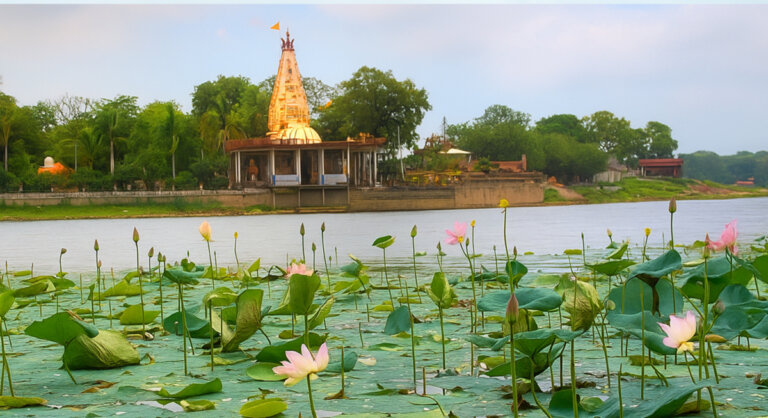
The temple stands beside the Hanumantal water reservoir, creating a distinctive visual setting where the entrance and exterior structure blend with the surrounding waterscape.
Several spires rise prominently above the complex, giving the entire structure the appearance of a massive religious group. Because the temple contains numerous altars, it offers a very different experience from a conventional single-sanctum temple.
The temple is described as having a total of 22 altars and shrines. This number makes its architectural and religious structure particularly distinctive. Each altar may hold its own religious significance, while the entire complex brings together various Jain Tirthankaras and related religious traditions in one place.
Another special chapter in its architectural history is the glasswork hall constructed in 1886. Built by Bholanath Singhai, this hall added a distinctive visual element to the interior beauty of the temple.
The diversity of historical idols further enriches its architectural heritage.
The best way to understand the architecture of this temple is not simply by looking at its spires. Visitors should observe the entrance, exterior walls, different altars, old stonework, idols, and the temple’s spatial relationship with Hanumantal.
In the morning or evening, when the surroundings of Hanumantal are relatively peaceful, the historical character of the entire complex can be felt even more strongly.
Amazing Chousath Yogini Temple of Jabalpur. Click Here
Sculptural Treasures:
The Hanumantal Bada Jain Temple houses a diverse collection of sculptures from various historical epochs. The temple’s artistic collection includes finely crafted images from the Kalachuri period, as well as sculptures from the Mughal, Maratha, and British eras. The presence of post-independence installations further emphasizes the temple’s ongoing spiritual significance and historical continuity.
Click here to know about Kalyanika Tapovan Temple Jabalpur
Key Features of Hanumantal Bada Jain Temple
The greatest feature of Hanumantal Bada Jain Temple is the way religious importance, history, and architecture come together within a single complex.
The first major feature is its 22 altars and shrines. Because of these, the temple is counted among the largest independent Jain temple complexes in India.
The second major feature is its history. The temple’s original construction is associated with 1686 CE, while significant reconstruction took place during the 19th century. Because of this long history, the temple has witnessed generations of religious activities and preservation efforts.
The third major feature is its ancient idols. The temple is associated with idols dating from the Kalachuri period, approximately the 10th to 12th centuries. Idols associated with the Mughal, Maratha, British, and modern periods are also mentioned as part of its heritage.
The fourth feature is its fort-like structure. Its numerous spires and massive exterior give it an appearance that differs from many conventional Jain temples. Accounts of Acharya Shantisagar’s visit in 1928 also highlight this distinctive characteristic.
The fifth feature is the glasswork hall dating from 1886, associated with Bholanath Singhai. It was an important part of the temple’s historic interior.
The sixth feature is its religious and community importance. The annual Jain procession celebrating the birth anniversary of Lord Mahavira begins here and proceeds toward Bada Phuhara. Scripture assemblies and religious classes are also reportedly conducted at the temple.
Taken together, all these features make Hanumantal Bada Jain Temple one of the places in Jabalpur where history is not simply read about but can actually be experienced through architecture and religious traditions.
Spiritual Significance:
As the primary Jain temple in Jabalpur, Hanumantal Bada Jain Temple plays a pivotal role in the city’s religious landscape. The annual procession celebrating Lord Mahavir’s birthday begins here and concludes at Bada Fuhara, symbolizing the temple’s central role in local Jain traditions. Daily scripture discussions (shastra-sabhas) and evening classes are held here, providing devotees with spiritual enrichment and religious education.
Click here to learn about Tripura Sundari Raj Rajeshwari Temple Jabalpur
Deities and Important Idols Inside the Temple
Hanumantal Bada Jain Temple is primarily an important pilgrimage site belonging to the Digambara Jain tradition. Therefore, the principal religious focus of the temple is on Jain Tirthankara idols and Jain religious traditions.
Available sources mention Lord Rishabhanatha or Adinatha as the principal deity associated with the temple. A beautifully ornamented idol of Lord Adinatha dating from the Kalachuri period is particularly noted.
The temple’s unique feature is that the religious experience is not limited to a single idol or altar. The entire complex reportedly contains 22 altars and shrines. Various altars contain Jain Tirthankara idols and other Jain religious images, giving the complex the character of a large religious pilgrimage center.
The historical periods represented by the idols are also fascinating. Along with Kalachuri-period idols, the temple is associated with idols from the Mughal, Maratha, British, and modern periods. This diversity connects the temple with the long history of Jain sculpture in central India.
There is also a historical reference to an idol of Goddess Padmavati associated with the temple. However, because of later reconstruction and changes within the temple, older online information about the current location or status of any particular idol should not be treated as definitive without local confirmation.
Therefore, while visiting the temple, it is better to check the information displayed near each altar or ask the temple management for details. This can help visitors avoid confusion regarding the identity and historical period of ancient idols.
Things and Places to See Inside the Temple
The Main Temple Complex with 22 Altars
The first thing that attracts attention inside the temple is the extensive religious complex containing 22 altars. Having such a large number of individual altars within one temple is one of its defining characteristics. Instead of rushing through the complex, visitors should take time to observe each section carefully.
The Ancient Idol of Lord Adinatha
Among the idols associated with the Kalachuri period, the beautifully ornamented idol of Lord Adinatha is particularly noteworthy. It is regarded as one of the important historical idols of the temple and provides an opportunity to understand the older traditions of Jain sculpture.
Kalachuri-Period Idols
The presence of idols dating from the 10th to 12th centuries significantly increases the historical importance of the temple. History enthusiasts may find it particularly interesting to observe the posture, craftsmanship, facial expressions, and stone carving of these ancient sculptures.
The 1886 Glasswork Hall
The main hall featuring glasswork, constructed by Bholanath Singhai in 1886, holds a special place in the history of the temple. This section is important for understanding the historical interior design of the temple.
Idols from Different Historical Periods
The temple is associated with idols ranging from the Kalachuri period to the Mughal, Maratha, British, and modern periods. This combination gives visitors a distinctive historical experience.
Temple Complex Facing Hanumantal
The surroundings of Hanumantal can be seen from outside and around the entrance of the temple. The combination of the religious complex and the historic lake makes the overall experience even more attractive.
Aarti, Worship and Bhajans at the Temple
When discussing religious activities at Hanumantal Bada Jain Temple, it is important to remember that the worship practices of Digambara Jain temples differ from the conventional aarti traditions of Hindu temples.
Worship of the Tirthankaras, abhisheka, scripture recitation, devotional hymns, and religious study are important activities within the Jain tradition.
Available descriptions mention daily scripture assemblies and religious classes in the evening. Visitors may participate in darshan, worship, abhisheka, devotional recitations, and religious readings according to Jain traditions.
Devotional music in Jain religious traditions includes praises of the Tirthankaras, devotional songs, hymns, and religious verses. Therefore, the spiritual atmosphere of the temple should not be understood as being limited only to bells and aarti.
The exact current timings of daily worship, abhisheka, and special religious programs are not always clearly available through online sources. If you wish to participate in a particular religious ceremony, it is best to confirm the schedule with the temple management before your visit.
Religious activities may be more elaborate during special occasions than on regular days. During Mahavir Jayanti, the procession beginning at the temple highlights its religious and social importance.
If you want to worship or meditate in a peaceful environment, morning may be a suitable time. Visiting during a religious event, on the other hand, can provide an opportunity to observe collective Jain worship, devotional singing, and religious activities more closely.
Major Festivals and Religious Events
As an important Jain religious center in Jabalpur, Hanumantal Bada Jain Temple hosts religious activities throughout the year.
One of the most important occasions is Mahavir Jayanti, the celebration of Lord Mahavira’s birth anniversary. Special religious ceremonies and a festive procession take place around this occasion.
According to available information, Jabalpur’s annual Jain procession begins at the temple and proceeds toward Bada Phuhara. During the procession, the temple and surrounding area become filled with religious enthusiasm.
During Mahavir Jayanti, devotees participate in religious rituals, worship, devotional recitations, and community activities. For travelers interested in understanding Jain social and cultural traditions, visiting during this period can provide a more immersive experience than visiting on an ordinary day.
Religious education is also an important part of the temple’s activities. Available sources mention daily scripture assemblies and evening classes. Such activities make the temple more than simply a place for darshan; they also make it a center for religious education and community interaction.
The temple’s history also includes references to major religious events such as Panch Kalyanak Pratishtha and Gajrath ceremonies. Information published about 2022 mentions a Panch Kalyanak Pratishtha followed by a Gajrath ceremony.
In addition, special worship, religious discourses, self-study, and other activities may be organized during occasions such as Paryushan according to the Jain religious calendar. However, the exact dates and programs for any particular year should be verified with the local temple management..
How to reach?
- By Road: The Hanumantal Bada Jain Temple can be easily reached by private vehicle, taxi, or auto-rickshaw from Jabalpur city.
- By Rail: Jabalpur Railway Station is the nearest railhead, located about 4 kilometers from the Hanumantal Bada Jain Temple.
- By Air: The nearest airport is Dumna Airport in Jabalpur, which is approximately 17 kilometers from the Hanumantal Bada Jain Temple.
Click here to know about Roopnath Dham Bahoriband.
Timing of Hanumantal Bada Jain Mandir Jabalpur
8 am to 7 pm (All day)
To know about the Amazing and beautiful Jabalpur Jain Temple. Please click here.
Temple Timings and Entry Fee
Online information regarding the timings of Hanumantal Bada Jain Temple varies somewhat. One major travel source lists the general visiting hours as 8:00 AM to 7:00 PM and indicates that entry is free. Some Jain temple directories, however, mention separate morning and evening visiting schedules.
Generally published online timing: 8:00 AM to 7:00 PM
Best Places to Visit Near the Temple
Hanumantal
The closest and most natural attraction is Hanumantal itself. The temple stands beside this historic lake, and the combination of the lake and temple is one of the defining features of the area.
After visiting the temple, spending some time around the lake and observing the historic surroundings can make the experience more memorable.
Rani Durgavati Museum
This is one of Jabalpur’s major museums, containing sculptures, inscriptions, and archaeological artifacts. It is an important destination for travelers interested in history and art.
Bhanwartal Garden
Located in the central part of the city, this popular park is a good option for families and travelers looking to relax for some time. It can easily be included in a city tour after visiting the temple.
Bada Phuhara
Bada Phuhara is a well-known area of old Jabalpur and is also associated with the Mahavir Jayanti procession that begins at the temple and proceeds here.
Kamania Gate
Located within the historic urban area of old Jabalpur, Kamania Gate is not far from the Hanumantal area. It can be included as part of a short city walk through the old streets and markets.
Madan Mahal Fort
History enthusiasts should consider combining the temple visit with Madan Mahal Fort. Its remains on a hill provide an important glimpse into the Gond history of Jabalpur.
Other Major Places to Visit Around the Temple in Jabalpur
Pisanhari Ki Madhiya
This famous Jain pilgrimage site in Jabalpur is one of the best places to combine with a visit to Hanumantal Bada Jain Temple. Located on a hill, the Jain complex is known for its peaceful surroundings and religious architecture.
If your main goal is to understand Jabalpur’s Jain heritage, visiting both Bada Mandir and Pisanhari Ki Madhiya during the same trip is highly worthwhile.
Gwarighat
Located along the Narmada River, Gwarighat is one of Jabalpur’s major religious destinations. The Narmada Aarti is one of its major attractions. In the evening, the riverfront atmosphere can transform the visit into a deeply spiritual experience.
Balancing Rock
This popular Jabalpur attraction consists of massive rocks that appear to be naturally balanced. Located around the Madan Mahal area, it can easily be included in a day-long city tour.
Bhedaghat and Marble Rocks
If you have more time, visit Bhedaghat, famous for its towering marble cliffs along the Narmada River. Traveling by boat between the marble cliffs is one of Jabalpur’s most famous experiences.
Dhuandhar Falls
Dhuandhar Falls can be combined with a visit to Bhedaghat. The Narmada River plunges through the rocky landscape, creating a mist-like effect.
If you have a full day, a route such as Temple → Madan Mahal → Pisanhari Ki Madhiya → Bhedaghat → Dhuandhar Falls can be planned.
Important Things to Keep in Mind During the Visit
Hanumantal Bada Jain Temple is a historic and active religious site. Therefore, visitors should treat it as a place of worship rather than merely as a tourist attraction.
Wear clean and respectful clothing when entering the temple. Avoid speaking loudly, behaving inappropriately, or engaging in activities that may disturb other devotees.
The historical idols are among the temple’s most valuable heritage elements. Follow local rules before touching any idol, altar, historic architectural feature, or religious object.
Take photographs only when photography is permitted. In particular, seek permission before using a camera or mobile phone during worship or religious ceremonies.
Different online sources may contain information from different periods regarding the idols. Therefore, old online articles should not be treated as the final authority regarding the current location of a particular idol. The interior of the temple has undergone changes and reconstruction over time.
Because the temple is located beside Hanumantal, visitors should exercise additional caution during the rainy season or wet weather. Children should never be left unattended near the lake.
If you visit during a religious event, follow the instructions of local devotees and temple management. To better understand Jain worship traditions, speaking with a knowledgeable person can make the experience more meaningful.
Most importantly, do not treat the temple merely as a place to take photographs. Its real beauty lies in its 22 altars, ancient idols, layers of history, and peaceful religious atmosphere.
Address and Google map of Hanumantal Bada Jain Mandir Jabalpur
Address: 5WJP+6WP, Hanumantal Rd, near Jai Maa Narmada, Nursery School, Hanumantal Ward, Jabalpur, Madhya Pradesh 482002
Medizin DissertationShri Supteshwar Ganesh Temple Jabalpur.
Images of Hanumantal Bada Jain Mandir Jabalpur


Complete Travel Guide to Hanumantal Bada Jain Temple
Reaching Hanumantal Bada Jain Temple is relatively easy because it is located in the old and central part of Jabalpur.
According to available travel sources, the temple is approximately 3 kilometers from Jabalpur Junction Railway Station. From the railway station, visitors can take an auto-rickshaw, taxi, or local transport to reach the temple.
How to Reach by Train?
Jabalpur Railway Station is the city’s major railway station and is connected by rail with several major cities across India.
After reaching the railway station, taking an auto-rickshaw or taxi toward Hanumantal is likely to be the most convenient option.
The distance is relatively short under normal traffic conditions, although travel time may vary because of roads and traffic in the old city.
How to Reach by Road?
Jabalpur is well connected by road with major cities of Madhya Pradesh.
After entering Jabalpur, travel toward the Hanumantal area and proceed to the temple. Telling a local auto-rickshaw driver “Hanumantal Bada Jain Temple” is generally the easiest way to identify the destination.
How to Reach by Air?
Jabalpur’s Dumna Airport connects the city with several major destinations.
A taxi or cab is the most convenient option for traveling from the airport to the temple. The actual distance and travel time will depend on the selected route and traffic conditions.
How Much Time Should You Spend?
For a simple temple visit, approximately 30 minutes to 1 hour may be sufficient.
However, if you want to carefully explore the historic idols, 22 altars, architecture, and surroundings of Hanumantal, you should allow more time.
How to Plan a One-Day Trip?
Begin your morning at Hanumantal Bada Jain Temple.
After visiting the temple, explore Bada Phuhara and other historic areas of the old city. You can then visit Rani Durgavati Museum and the Madan Mahal area.
If time permits, include Pisanhari Ki Madhiya as well.
For an extended day trip, you can visit Gwarighat in the evening and experience the atmosphere along the Narmada River.
If you have a second day, it is more comfortable to keep Bhedaghat, Marble Rocks, and Dhuandhar Falls as a separate trip.
Best Time to Visit Hanumantal Bada Jain Temple
The period between October and March is generally more comfortable for visiting Hanumantal Bada Jain Temple because the weather in Jabalpur is relatively pleasant during these months.
This season also makes it easier to explore the city’s other historic and natural attractions along with the temple.
Morning is a good option for travelers looking for a peaceful environment. It may also provide an opportunity to experience religious activities and observe the temple’s architecture without heavy crowds.
During Mahavir Jayanti, the temple and surrounding area can take on a completely different atmosphere. The Jain procession and other religious activities can make the visit much more lively and immersive.
During summer, temperatures in Jabalpur can rise considerably in the afternoon, so it is better to explore the temple and surrounding open areas in the morning or evening.
During the monsoon, Hanumantal can look particularly attractive, but visitors should be cautious about wet surfaces and changing travel conditions.
If your goal is simply darshan, you can visit on any convenient day.
However, if you want to experience history + architecture + Jain religious heritage + Jabalpur tourism together, October to March is likely to provide a more comfortable travel experience.
Suggested One-Day Travel Plan
7:00–8:00 AM — Reach the Hanumantal Area
Begin your day by experiencing the atmosphere of old Jabalpur. The area around the temple may be relatively peaceful in the morning.
Confirm the temple’s current visiting arrangements locally before entering.
Morning — Visit Hanumantal Bada Jain Temple
Take time to explore the 22-altars complex, historic idols, and fort-like architecture.
Do not rush through the temple after viewing only the main idol. Spend time understanding the different altars and historic architectural elements.
Afterward — Hanumantal and Old City
After leaving the temple, explore the surrounding old area. Local markets and historic urban surroundings can give you a glimpse into the older character of Jabalpur.
Afternoon — Rani Durgavati Museum
If you are interested in history and sculpture, include the museum in your itinerary. It contains regional sculptures, inscriptions, and other archaeological material.
Late Afternoon — Madan Mahal and Balancing Rock
Continue exploring the historic side of Jabalpur by visiting Madan Mahal Fort and the surrounding area.
Evening — Gwarighat
If you still have enough time and energy, visit Gwarighat in the evening and experience the religious atmosphere along the Narmada River.
If You Have a Second Day
Keep Bhedaghat, Marble Rocks, and Dhuandhar Falls for the second day. These attractions are not immediately close to the temple, so combining them into a separate day is more practical.
In this way, a visit to Hanumantal Bada Jain Temple becomes much more than a temple visit. It can become a complete experience of Jabalpur’s history, religion, architecture, and natural beauty.
Other places to visit in Jabalpur.
- Dhuandhar Falls, Jabalpur
- Marble Rocks, Jabalpur
- Kedarnath Temple, Jabalpur
- Dumna Nature Reserve Park, Jabalpur
- Balancing Rock, Jabalpur
- Madan Mahal Fort, Jabalpur
- Rani Durgavati Museum, Jabalpur
- Chausath Yogini Temple, Jabalpur
- Bargi Dam, Jabalpur
- Tilwara Ghat, Jabalpur
- Pisanhari ki Madiya, Jabalpur
- Chataniya City Hanuman Temple
- Sea World Water Park
- Treasure Island, Mall
- Bhawartal Garden
- Kankali Devi Temple
- Sangram Sagar Lake
- Sri Vishnu Varaha Mandir
- Gwari Ghat
Click for information about Kankali Devi Temple Tigwa.
Interesting information about the Katni City of Madhya Pradesh.
Click here to learn about Roopnath Dham Bahoriband.
Beautiful Waterfall of Katni City.
Click to learn about the Metro Museum, Delhi.
To know about Mahakaleshwar Jyotirling of Ujjain click.
Delhi Handcrafted Bazaar Dilli Haat.
Conclusion: One of Jabalpur’s Heritage Sites Worth Exploring Closely
Hanumantal Bada Jain Temple is one of Jabalpur’s historic heritage sites that cannot be fully understood by simply calling it an ordinary temple.
Its history associated with 1686 CE, 19th-century reconstruction, 22 altars, idols representing different historical periods, the 1886 glasswork hall, and fort-like architecture give it a distinctive position among the important Jain religious sites of central India.
The most fascinating aspect of this temple is that its history is not locked away inside a museum display. It can be seen in the temple’s walls, spires, altars, and centuries-old idols.
On one side lies the water of Hanumantal, while on the other stands the massive temple with its numerous spires. Together, they create a distinctive picture of the historic religious landscape of old Jabalpur.
For history enthusiasts, the Kalachuri-period idols are a major attraction. For architecture lovers, the fort-like appearance creates a sense of wonder. For devotees, the complex with its 22 altars provides a deeply spiritual environment.
If you are planning a trip to Jabalpur, be sure to include Hanumantal Bada Jain Temple in your itinerary.
Especially if you want to experience religious heritage, ancient sculpture, and the historic character of old Jabalpur together, this temple can make your journey far more memorable than a conventional sightseeing trip.
Before You Visit: Temple timings, special worship schedules, religious events, and the current location or status of particular idols may change. Therefore, if you are planning to visit during a special occasion, confirming the latest information with the local temple management is the most reliable approach.
 2
2 20
20 20
20